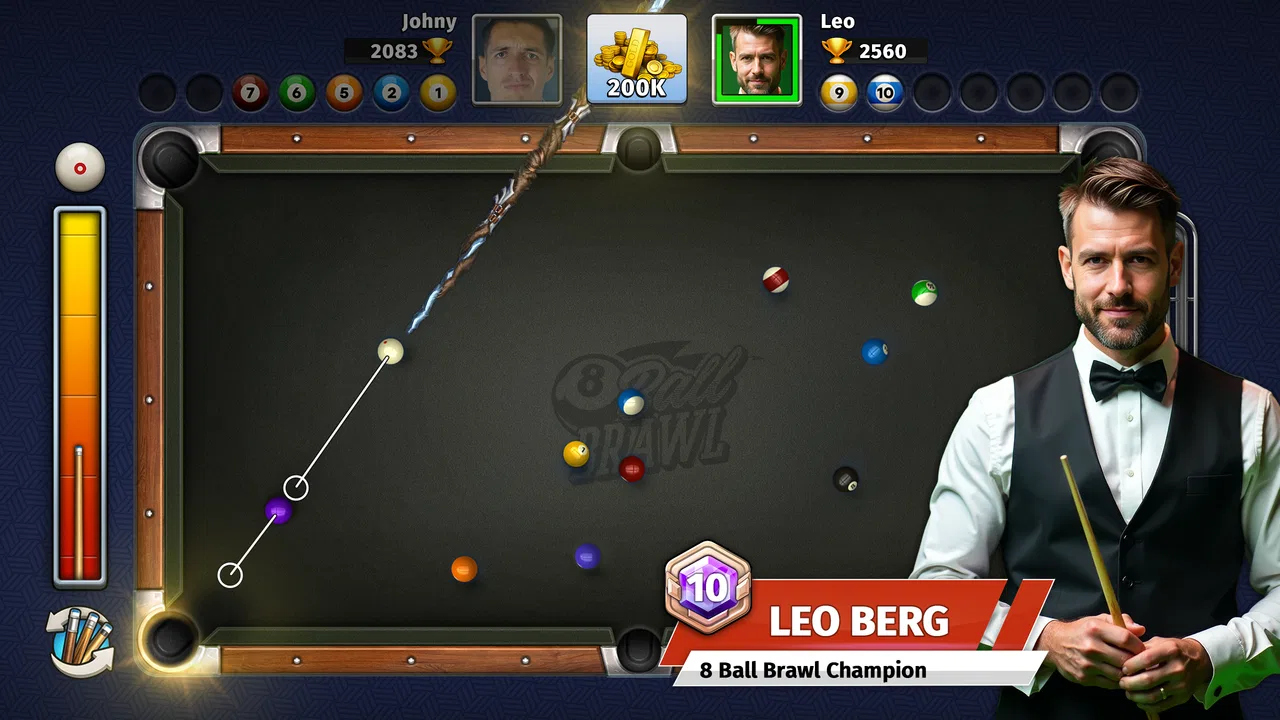
8 Ball Brawl: Pool & Billiards
- 4.5
- Rating
- 1.00M
- Installs
- Free
- Price

 Analysis by App-foxy
I approached 8 Ball Brawl: Pool & Billiards expecting a quick mobile pool game, but its main appeal is more focused than that. It is a sports game built around competitive 8-ball matches, with the pressure coming from making the right shot rather than simply clearing a table at your own pace. That difference matters: a casual pool app can be relaxing, while a PvP-oriented game asks me to think about position, risk, and the consequences of one missed attempt.
After spending time with it, I see a game that works best in short sessions. I can open it when I have a few minutes, play with a clear objective, and stop without needing a long campaign commitment. At the same time, the competitive format means it is not always soothing. A poor decision can turn a promising rack into a frustrating loss, especially when I rush a shot or attempt something flashy without a reliable follow-up.
How the first matches establish a reason to keep playing
The early appeal comes from the simplicity of the task. I do not need to learn a large collection of sports rules before starting: line up the cue, judge the angle, choose the amount of force, and try to control what happens next. That approachable structure makes the game suitable for someone who knows basic pool or someone who only wants a familiar sports format on a phone.
You May Also Like

 Google Keep - Notes and lists
Google Keep’s Quiet Growth Shows the Appeal of Simpler Notes
As mobile work gets busier, Google Keep keeps winning a simple contest: capture a thought quickly, find it later, and get on with the day.

 Blood Strike: 2.5 Anniversary
Blood Strike’s Loadouts Turn Every Drop Into a Tactical Gamble
A close look at Blood Strike’s custom loadouts: how fast access to signature weapons reshapes its battle royale rhythm, rewards preparation, and narrows the gap between fights.

 Pandora - Music & Podcasts
Pandora’s Music Is Easy to Start, but Harder to Recover
Pandora’s strength is its low-effort path from a seed to a station. Its weak spot is how much confidence it asks you to place in connection, setup, and quiet recovery.

 8 Ball Pool
 Is Built on Rivalries, Rematches, and Routine
A close look at the rivalries, rematches, shared routines, and unanswered safety questions that turn a quick pool match into a persistent mobile community.

 Samsung Music
’s Quiet Strength Is Playing What You Already Own
Its reach comes less from spectacle than from dependable access to a personal library. That simplicity is both the app’s strongest retention engine and its ceiling.

 AccuWeather: Weather Radar
AccuWeather Review: A Quick, Clear Forecast for Everyday Decisions
For everyday plans, the best forecast is the one you can understand quickly. AccuWeather makes rain timing, radar, and local conditions easy to act on, with a few trade-offs.
More From Our News Desk



What gives the opening matches more purpose than a solitary practice table is the competitive framing. Each turn carries visible weight because the other player may get an opportunity if I leave an easy shot. That immediately creates a useful early goal: improve enough to finish a rack cleanly instead of treating every shot as an isolated action.
I found it helpful to set small personal targets rather than obsess over winning every match. In the beginning, I focused on avoiding careless fouls, choosing safer shots when the table was awkward, and leaving the cue ball in a workable position. Those goals make progress feel tangible even when the result is not in my favor.
The game is also easy to understand in a social sense. Someone who has played pool with friends can recognize the rhythm almost immediately, while a newcomer can watch the table and learn through repetition. That makes it more inviting than a complex sports simulator with multiple controls, formations, or long tutorials.
Why the basic loop remains readable
Every turn gives me a compact decision. I need to decide whether the obvious pocket is actually the best choice, whether the cue ball will finish somewhere useful, and whether a difficult attempt is worth the risk. These decisions are small, but they prevent the experience from becoming a mindless sequence of taps.
That is where the game earns its place among mobile sports titles. It does not need a large roster or a complicated season structure to create tension. The table itself supplies the problem, and the opponent supplies the urgency. I can play a quick match casually, but I can also treat the same rack as a puzzle when I want more concentration.
One practical tip is to stop thinking only about the ball I am pocketing. Before taking a shot, I try to identify where the cue ball is likely to finish and what that means for the next turn. This habit is more valuable than attempting difficult bank shots early. It also gives beginners a clear way to improve without needing advanced terminology.
Progress signals, unlock expectations, and the value of each match
Progress in a competitive pool game should feel connected to better decisions, not just to time spent tapping the screen. Here, the strongest progress signal is my own consistency. I notice improvement when I stop giving away easy opportunities, plan one shot further ahead, and recognize when a defensive choice is wiser than a low-percentage pocket.
That kind of progress is less dramatic than collecting a large number of items, but it suits the sport. Pool is built around precision and judgment, so a player who learns to control the table has made meaningful progress even if the interface does not constantly celebrate it.
The game’s free entry also makes it easy to try without committing money first. It is listed as free, while optional purchases range from $0.99 to $99.99 per item. I would recommend treating those purchases carefully and deciding what I actually want from the experience before spending. A competitive game can feel less satisfying if I start measuring improvement by purchases rather than by play.
For me, the most useful way to evaluate any unlock or reward is to ask whether it changes how I approach a match or merely gives me another reason to return. Cosmetic or collection-oriented progress can be enjoyable, but it should not replace the central satisfaction of making a difficult shot. Players who want a deep career mode with clearly defined long-term milestones may find the format less compelling than a traditional pool simulator designed around seasons or tournaments.
The public response suggests that the game has found a substantial audience: it carries an average rating of 4.5 from around 15 thousand ratings and has passed 1 million installs. I take that as a sign that the quick competitive concept works for many players, not as a guarantee that every match will suit every taste.
What to track if you want real improvement
I recommend watching three things during play: the quality of the opening break, the position of the cue ball after each successful shot, and the number of turns lost to impatience. Those observations tell me more than a simple win streak. A player may win against a weaker opponent while still developing habits that fail badly against someone more careful.
Another useful routine is to review the shot immediately after a mistake. Instead of blaming the aim line, I ask whether the selected shot was sensible in the first place. Sometimes the problem is not execution but planning: I chose a pocket that left no comfortable continuation, or I tried to clear too much of the table at once.
This is also where the game can appeal to people who enjoy gradual mastery. The controls may be approachable, but the table does not become predictable simply because the rules are familiar. Small improvements in power and positioning can make a short session feel worthwhile.
Difficulty, pacing, and the point where matches become tense
The difficulty curve feels tied to decision-making rather than to a long list of mechanics. Early play is understandable because I can concentrate on aiming and pocketing. As the pressure increases, those basic actions are no longer enough. I need to consider table layout, the order of shots, and whether a safe attempt is better than an ambitious one.
That creates a natural learning curve, but it can also expose a weakness in the format. When I lose because of a clear mistake, the lesson is useful. When a match feels decided by one awkward situation or a rushed moment, the experience can be harder to enjoy. Competitive pool has little room for recovery once an opponent gains control, so the pacing is not always comfortable.
I like the short-session structure because it respects my time. I can fit a match into a break, then return later without needing to remember a complicated story or campaign objective. The downside is that one loss can tempt me into immediately playing again, even when I am already making worse decisions. The game’s compact design makes that “one more match” feeling particularly strong.
My best results came from slowing down before important shots. I used the early part of a rack to gather information rather than forcing a difficult clearance. If the table offered a simple route, I chose it. If the next position looked poor, I accepted a less exciting shot instead of chasing a perfect-looking result.
That approach may sound conservative, but it is exactly what separates a quick novelty from a game with staying power. The challenge is not only whether I can pocket a ball; it is whether I can manage the whole sequence without creating a problem for myself.
Who will enjoy the challenge, and who may not
This is a good fit for players who like direct competition, sports games that reward accuracy, and matches that can be completed in a relatively short sitting. It is also a reasonable choice for someone who wants to practice strategic thinking through a familiar activity rather than learn a complicated control scheme.
I would be more cautious recommending it to players who dislike losing progress in public matches, prefer relaxed solo play, or want a highly structured career experience. A traditional offline pool game may be better for someone who wants to repeat shots without opponent pressure. A fuller sports simulation may also be preferable if the important part for that player is team management, leagues, or a broad roster of events.
The age rating is Everyone, which matches the accessible nature of the sport. Still, the competitive atmosphere can feel more demanding than the rating alone suggests. Younger players may understand the rules quickly, but they may need help developing patience and accepting losses without immediately spending on optional items.
Retention pressure and the careful balance of free play
The game’s strongest retention tool is the match itself. A close rack naturally creates the desire to try again, especially when I feel that one better decision would have changed the result. That is a healthy kind of replay value when it encourages learning. It becomes less healthy when I continue playing while frustrated and start making impulsive shots.
The free-to-play structure deserves attention here. Since the game costs nothing to start, it is accessible, but the presence of in-app purchases means I should decide in advance how much optional spending fits my habits. I would not buy anything simply because I lost a match. That turns a temporary mistake into a purchase decision, and it does not improve my understanding of the table.
A better approach is to use a personal stopping rule. For example, after a few rushed losses, I would close the game and return later rather than chase a better result immediately. This is especially useful in a PvP format because the next opponent may be perfectly manageable, yet my own impatience can make the match feel harder than it is.
The version available is 1.17, and the game supports devices running Android 8.0 or later. That makes checking device compatibility worthwhile before downloading, particularly on an older phone or tablet. I also prefer playing on a screen where the aiming line and table details are easy to read; a cramped display can make precision feel more difficult than it should.
One less obvious trade-off is that the game’s simplicity makes every flaw more visible. In a large sports title, a slow menu or a small control annoyance can disappear among many systems. In a focused pool game, aiming, timing, and match flow are the entire experience. If those elements feel good, the game is immediately satisfying; if they feel awkward to me, there is less else to compensate.
A realistic everyday session
Imagine opening the game during a short commute or while waiting for an appointment. I can play one match, use the result as a quick test of concentration, and leave. If I win, I may want to continue because the rhythm is working. If I lose, I can still take something useful from the rack by identifying the shot where I gave control away.
That scenario is where the game makes the most sense. It does not demand a large uninterrupted block of time, and its central activity is understandable without preparation. However, I would avoid starting a match when I know I have only a few seconds, because a competitive turn deserves enough attention to aim properly. The game is quick, but it is not entirely mindless.
My progression verdict after weighing the whole loop
I think the game succeeds when its goals stay close to the table: pocket the right balls, manage position, avoid unnecessary risks, and become more reliable under pressure. Those objectives are enough to sustain play for people who enjoy improving through repetition. The competitive structure gives ordinary shots meaning, while short sessions make it easy to return without a major time commitment.
Its limitations are equally clear. Players looking for a rich solo campaign, a broad sports-management layer, or a completely relaxed experience should look elsewhere. The free-to-play model also means I would keep optional spending under control, especially if I am prone to chasing losses. A strong rating and a large install base show that the concept connects with many people, but they do not remove the personal question of whether PvP pool is the kind of pressure I enjoy.
TapHit Labs has chosen a focused direction rather than trying to turn 8-ball into an oversized sports package. In my experience, that focus is the reason the game is easy to recommend to the right person. I would suggest it to a friend who wants a compact competitive pool game where better planning matters more than flashy complexity.
My final advice is to play it as a skill game first and a progression game second. Use each rack to improve shot selection, cue-ball control, and patience. If those goals keep you interested, the repeated matches have real value. If you need a long list of unlocks or a forgiving solo structure to stay engaged, this particular approach may feel too narrow. For players who enjoy the tension of a well-planned 8-ball turn, though, it offers a convincing mobile sports experience without making the basic idea difficult to understand.
FAQs for 8 Ball Brawl: Pool & Billiards
01What is 8 Ball Brawl: Pool & Billiards?
8 Ball Brawl: Pool & Billiards is a mobile pool game focused on classic eight-ball matches and competitive billiards gameplay. It is designed for quick sessions, allowing players to practice their shots, improve cue control, and challenge opponents in different match situations. Before downloading, keep in mind that the overall experience may include progression systems, advertisements, or optional in-app purchases depending on the platform and version available.
02Can I play 8 Ball Brawl: Pool & Billiards offline?
The availability of offline play can depend on the specific game mode and the version installed on your Android or iOS device. Some pool games allow practice or single-player matches without an internet connection, while online competitions, leaderboards, rewards, and multiplayer features usually require connectivity. It is recommended to launch the game once while online and check which modes remain accessible when mobile data or Wi-Fi is disabled.
03Does the game support online multiplayer?
8 Ball Brawl: Pool & Billiards is intended to provide a competitive pool experience, so players should expect multiplayer-oriented features or challenges in at least part of the game. Online modes may involve matchmaking, invitations, rankings, or competition against other users. A stable internet connection is important for accurate shot timing and preventing interruptions, and some online features may only become available after completing an introductory tutorial or progression stage.
04Is 8 Ball Brawl: Pool & Billiards free to download and play?
The game may be available as a free download, but free access does not necessarily mean that every feature is completely unrestricted. Like many mobile sports and arcade titles, it can include advertising, virtual currency, unlockable content, or optional in-app purchases. Players should review the store listing and the purchase settings on their device, especially if children may use the app, to understand possible costs before starting.
05What devices are compatible with 8 Ball Brawl: Pool & Billiards?
Compatibility depends on the operating system requirements published on the official Google Play Store or Apple App Store listing. Before downloading, check the required Android or iOS version, available storage space, and whether your device supports the game’s graphics and online services. Older phones and tablets may install the application but deliver slower performance, longer loading times, reduced visual quality, or occasional instability during matches.
Pros
- Quick matches are ideal for short gaming sessions.
- Simple controls make aiming and shooting easy to learn.
- Online competition adds variety beyond solo play.
- Different table designs give matches visual variety.
- Games run smoothly on most modern mobile devices.
Cons
- Progress can feel slow without frequent play.
- Some opponents may have noticeably stronger equipment.
- Online matches depend heavily on a stable connection.
- Ads may interrupt the experience between games.
- Limited offline options reduce its usefulness without internet.

8 Ball Brawl: Pool & Billiards
Gallery